Many of you have asked details about the compass stand that we used during our Greenland crossing. Finally, I will give you details and drawings, so you can build your own! We (our expedition) think that it is the best compass stand there is! And it’s also a nice DIY project!
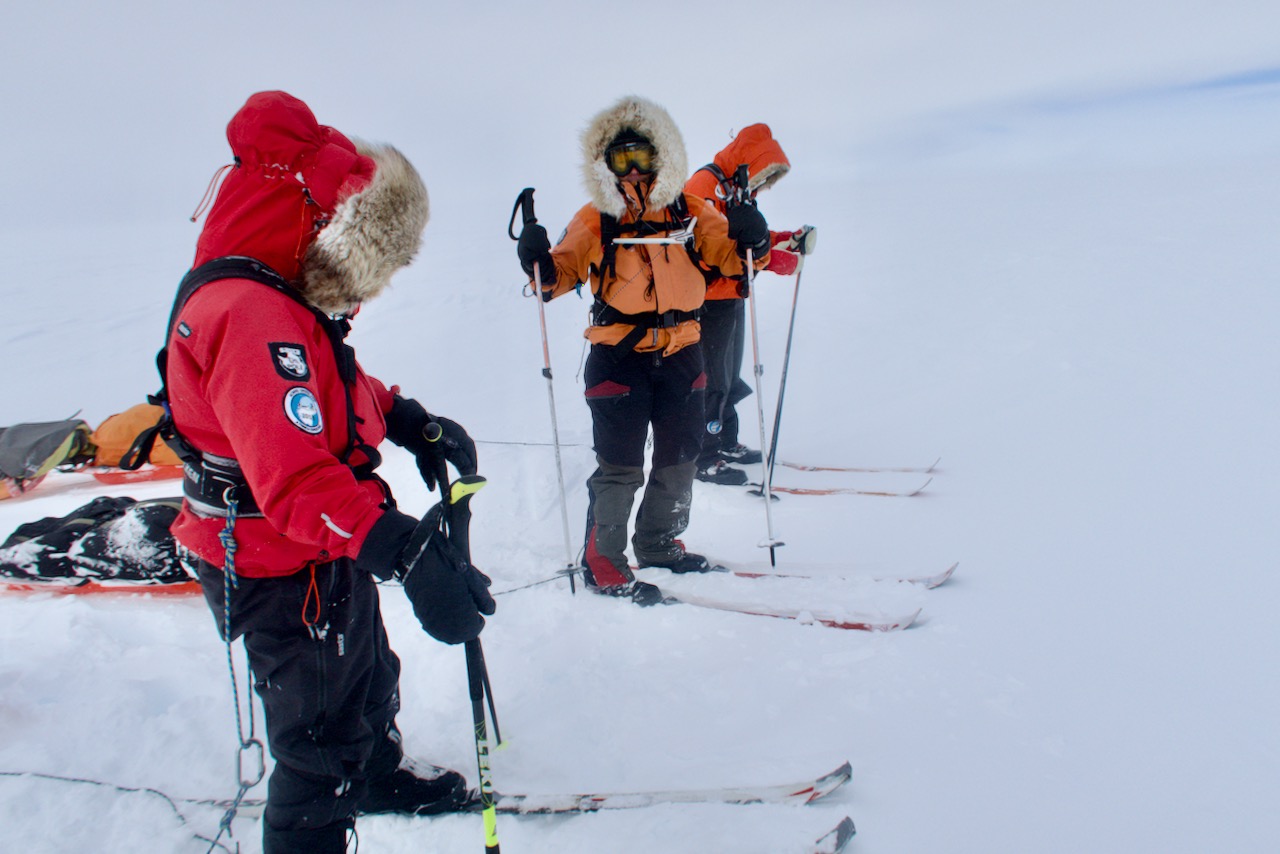
The most important thing is that you have the compass stand attached to the harness high enough, at chest height. (See the pictures below.) In this way, you don’t have to ski with a bent neck, and at the same time you can see ahead and clearly the compass itself. It’s also really easy to build and lightweight! We used Fjellpulken’s harnesses and the carabiners of our compass stand were a perfect fit for the harness! The cord lock allows you to lower the compass stand down if you have a break, and you don’t want the compass to be in you way.
The summer is around the corner, but it’s time to look back at the Svalbard winter expedition for one final time. The focus is now on the gear I used during the trip.
On my final equipment list for the Svalbard expedition, I had 126 items. Some of the list’s items, which belonged to the category unnecessary, I removed during the planning phase. The removed items were most spare clothes and spare equipment. The rest of the equipment on the list was more or less important or necessary. Some equipment belonged to the category comfort, but those equipment contributes greatly to how you enjoy the journey.
You can download my equipment list for the Svalbard 2016 expedition: Svalbard2016 GEAR (PDF)
Below I have listed the top 5 equipment that I experienced that contributed to how comfortable and successful the journey was. I would absolutely take with me these equipment again on asimilar winter expedition.
Top 5 Winter Expedition Equipment:
1. Inflatable Mattress – Thermarest NeoAir All Season
A month before the Svalbard expedition, I did a short winter tour in Koli National Park. It was the first real winter test for my Thermarest NeoAir All Season mattress. I had used it several times in the summer, autumn and spring, but never in the winter. It was under that trip I concluded that it’s a thousand timesmore comfortable than a foam mattress and I was really rested in the morning. On Vatnajökull, for example, I slept directly on my Thermarest Ridgerest Solar foam mattress, and I remember that my arm got numb every night and my back hurt in the morning. It was easy to take the decision tobringthe mattressto Svalbard. I like the mattress because it’s light, warm, comfortable and when deflated it doesn’t take much space. In the winter it is not good to inflate the mattress by blowing, because the moisture is collected inside the mattress and then freezes. Therefore I have a small battery powered electrical pump to the mattress, but to Svalbard I borrowed a pump sack from a friend, because the electrical pump is not so efficient. The pump sack worked great after you got used to it after couple of days. Under the NeoAir I had the Ridgerest foam mattress, just for safety’s sake, if the NeoAir would have gone flat.
2. Vapour Barrier Socks – Rab VB Socks
First some information aboutVB socks.The idea is to dress a pair of liners on your feet as base layer, on top of those these waterproof VB socks,and outside of those a pair of thick and warm ski socks, and of course the ski boots on top of that. In this way the moisture will not get through fromthe feet to the warm socks and boots, and that prevents freezing condensation and they hold heatbetter. These Rab VB Socks wasthe equipment that I was most skeptical about, but because the socksweighed almostnothing, I decided to take them with me. I had heard very good reviews aboutthem, but I hadn’t had time to test them properly before departure. Once we set of skiing on Svalbard I decided to give them a try, and I was really, really surprised how well they worked. I was worried that the socks would cause chafing or blisters, but in the end I think they prevented that. Under the whole trip I got only a few small blisters under my big toes and a small blister on one of my heel. With some sports tape I easily fixed those problems. The ski boots and the thick ski socks were dry throughout the whole expedition.
3. Ski boots – Crispi Stetind GTX
Last year, during the expedition on Vatnajökull, I had a pair of ski boots (Alpina BC 1550) that weren’t so good. Actually they were horrible. I got some nasty blisters on my feet, which affected negatively my skiing. They weren’t waterproof at all, so I had soaking wet boots throughout the whole trip, except for couple of days I dried them directly over the cooking stove. In the early winter I bought a new pair of ski boots, Crispi Stetind GTX. I was first worried that I wouldn’t have time to break them in, but I had time to make a few ski trips with the boots before the expedition. In most of my shoes and boots I use custom made insoles, because it’s really difficult for me to find shoes that fits my feet. For some reasonthe insoles in the Stetind bootsfitperfectly my feet, and they were really comfort. The boots are very steady and sturdy, but enough soft for skiing. The thing I like most is that they are waterproof! If you like to go uphill with crampons, the Black Diamond Contact Strap fits perfectly on these boots.
4. Devold Merino
Under a winter expedition you don’t change your clothes so often. Therefore you have to wear really comfortable clothes, especially for the base layer. I haven’t tried many brands of merino wool garments, but I have been really satisfied with the Devold Expedition brand. On Svalbard we changed our base layers once, except for our underwear that we changed more often.
5. Durable spoon – Sea To Summit Alpha Long Spoon
The Sea To Summit Alpha Long Spoon is the best spoon when you are eating directly from freeze dried food bags. Because of the length of the spoon, it is easy to get all the way to the bottom of the bag. One more thing is that it’s really durable. I hadn’t thought much about this feature, but in harsh expedition conditions it’s proved to be an important feature. To Svalbard I had with me one Alpha Long Spoon and two Light My Fire Sporks. I use Sporks when eating in the tent. Both of my Sporks broke into two pieces. The total amount of broken Sporks in our three person tent, during our expedition, was four! Well, the cold temperature and the frozen food may have had something to do with the breakage of the Sporks, but now I understand why some spoons are made from strong aircraft aluminum alloy. Maybe I will til the next expedition get a Spork Titanium? The cons of the aluminum or titanium spoon is that it’s not Teflon friendly.
The Alpha Long Spoon compared to the two broken Sporks.
If you are interested in the winter clothing, I have written a separate blog post about Layers For the Cold.




 Frida Pelin